



A highly flavored, late-season dessert apple, perfect for organic production.
Amoore Sweet Nectarine on BY520-9 (Nematode Resistant) (Spring 2027)

A flavorful yellow-fleshed nectarine cultivar from Arkansas. Also known as Ark. 765.
This nectarine tree is vigorous, consistently productive, and cold hardy, with demonstrated flower bud survival at 5° F. Amoore Sweet has shown resistance to bacterial spot, but, like most nectarines, it is susceptible to brown rot, and application of a fungicide is recommended in all areas where brown rot occurs. Nectarine trees are self-fertile and do not require a second variety as a pollenizer.
The fruit ripens early-mid season (5 days after Bradley, or 6 days after Arlington). It is medium sized with a yellow-orange skin that is blushed red, and yellow clingstone flesh. It holds up exceptionally well in storage and the fruit is considered to be of excellent quality. Amoore Sweet is a low-acid nectarine, with non-melting flesh that is highly flavored with somewhat tropical notes.
Amoore (pronounced amóray) Sweet and its sibling Bowden come from the peach and nectarine breeding program at the University of Arkansas, which has also produced Arrington, Bradley, Effie, and Westbrook. This program aims to produce peach and nectarine cultivars suitable for commercial production and sales. Amoore Sweet is named in honor of professor James M. Moore, who directed the fruit breeding program at the University of Arkansas between 1964 and 1996. Amoore Sweet was released in 2012.
Error
Please Confirm
The Fruit
Fruit Type
Category: Nectarine
Subcategory:
Fruit Uses & Storage
Uses: fresh eating, jam, baking, canning, freezing
Storage duration: less than one month (approximate, depending on storage conditions)
Fruit Appearance
Skin color: red
Flesh color: yellow
Fruit Origins
Parentage: Ark. 699 × Ark. 663 (breeding selections)
Origin: Clarksville, AR
Introduced in: 2012
Introduced by: University of Arkansas Agricultural Experiment Station
The Environment
Calendar & Geography
USDA zones: 5 - 9
Chill hours: 800
Ripening date: Aug 08 (approximate, in New York State) + 0 days after Redhaven
Tree Height & Spacing
glossary
Rootstock: BY520-9 (Nematode resistant) Rootstock
Rootstock size class: Standard (100% Size)
Tree spacing: See details
Good for wildlife planting? N
Diseases & Pests
glossary
Bacterial Spot: Very Resistant
Black Rot or Blossom End Rot or Frogeye Leaf Spot: Susceptible
Pollination
Pollination Factors
glossary
Bloom group:
Is it self-fertile? Y
Is it fertile? Y
Rootstock size class:
Standard (100% Size)
Pollination Partners
This table shows the first few results from a full search for pollenizers of Amoore Sweet Nectarine on BY520-9 (Nematode Resistant). Please see our Pollenizer Search to run other queries and read how the application uses various factors. Also read more about fruit tree pollination.
See all pollination matches for Amoore Sweet Nectarine on BY520-9 (Nematode Resistant)
Featured Products
A few things we're loving right now...
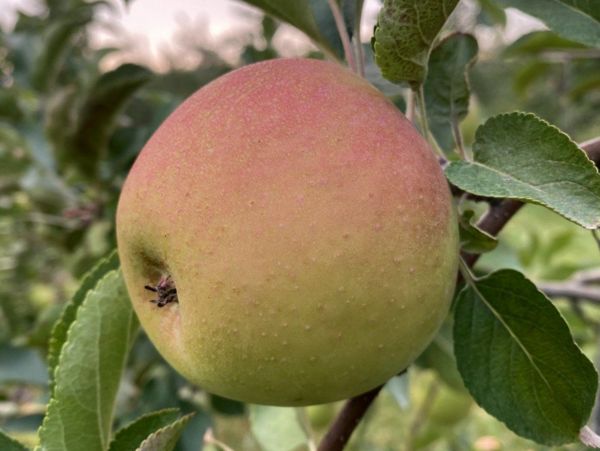
GoldRush Apple on G.890

Harrow Crisp Pear on OHxF 87
A modern, self-fertile, fireblight-resistant pear from Canada.

Sweetheart™ Cherry on Mahaleb
This is an easy, self-fertile sweet cherry.

Winecrisp™ Apple on B.118
A beautiful purple, late-season, disease-resistant dessert apple.